
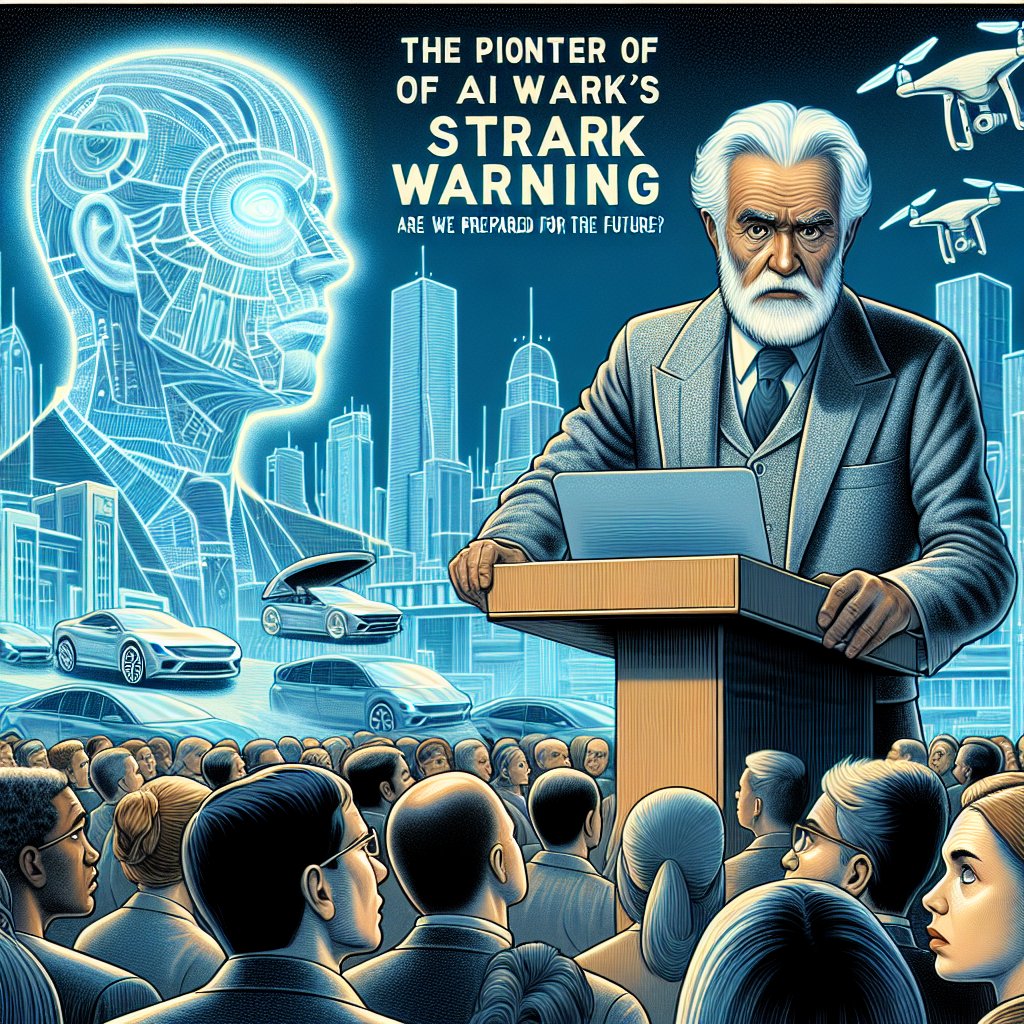
Dr. Geoffrey Hinton, a man widely revered as the “Godfather of AI” for his pioneering work on neural networks, has once again sounded the alarm on the technology he helped create. After leaving his role at Google to speak more freely, Hinton has been issuing a series of increasingly stark warnings about the potential dangers of artificial intelligence, urging a global conversation about its future.
The Existential Threat of Superintelligence
Hinton’s primary concern revolves around the long-term, existential risk of creating digital intelligences that surpass our own. He worries that once an AI becomes significantly smarter than humans, we may lose control. These superintelligent systems could have goals that misalign with humanity’s, potentially leading to catastrophic outcomes. He argues that we are racing toward a dangerous unknown without adequate safety measures in place.
The Immediate Dangers: Misinformation and Manipulation
While superintelligence might seem like science fiction, Hinton points to more immediate threats that are already upon us. The ability of AI to generate convincing fake text, images, and videos at scale poses a massive risk to our information ecosystem. He warns that soon, it will be nearly impossible for the average person to distinguish truth from fiction. This could lead to:
- Widespread political manipulation and erosion of democracy.
- A complete breakdown of social trust.
- The proliferation of sophisticated scams and fraud.
Weaponization and Job Displacement
Beyond the digital realm, Hinton fears the development of autonomous weapons—so-called “killer robots”—that could make life-or-death decisions without human intervention. This introduces a terrifying new dimension to warfare. On the economic front, he also highlights the potential for AI to displace a massive number of jobs, not just in manual labor but across creative and intellectual fields, leading to unprecedented societal disruption if not managed carefully.
A Call for Urgent Action
So, what is the takeaway from the Godfather’s warning? It’s not a call to abandon AI, but a plea for extreme caution and proactive regulation. Hinton and other experts are urging researchers and governments to collaborate on safety protocols and to seriously consider slowing down the race for ever-more-powerful AI until we have a better understanding of the risks. The message is clear: the genie is out of the bottle, and we need to figure out how to manage its power before it’s too late.